Equipment management · Access control · Reservations · Hazardous chemicals · Safety exams · Billing · Monitoring
Integrated all-in-one lab management platform
Designed for universities and research institutes, it covers the full lab lifecycle from equipment management to safety monitoring: equipment assets and maintenance, access control and reservations, hazardous chemicals and smart cabinets, safety exams and safety incidents, environmental monitoring, and billing and a Mini Program portal.
Helps labs achieve standardized equipment management, secure real-time monitoring, and digital operations, with support for both the management console and the Mini Program.
Devices · security · booking · billing
One Platform, Full Coverage
Integrated capabilities spanning equipment, access control, booking, hazardous chemicals, safety exams, monitoring, and billing.
Build equipment records supporting category, owning lab, storage location, brand and model, purchase date, cost and value history, with support for tags and bulk import.
Tally equipment counts and total asset value by lab, category and value range, with report export and depreciation analysis to meet the needs of higher-level audits and decision-making.
Repair request logging, dispatch handling, maintenance records and parts replacement, plus servicing plans and execution records make the entire equipment lifecycle queryable and traceable.
Bookings and check-ins automatically generate usage records—who used which device, when, and for how long—and support aggregating machine hours and utilization by device, person or lab.
Access permissions are managed per university lab; devices/workstations can be booked by time slot with approval and conflict detection, and once a booking is approved, access is granted automatically, supporting 24-hour availability.
Hazardous chemical records, one-bottle-one-code, inbound and inventory management, requisition application and approval, smart cabinet opening and return logs — fully traceable end to end.
Lab safety admission question bank, exam sessions, online answering and submission; passing automatically grants booking/access permissions, while failing prevents booking.
Security incident reporting, handling workflows and statistical analysis; cameras and recording, environment and hardware alerts, and operation auditing — for routine, continuous security monitoring.
Set billing rules per device or per duration, automatically generate usage invoices, and reserve payment-interface integration to facilitate open sharing and cost accounting.
Students and teachers handle reservations, access check-in, secure exams, and notification viewing through the Mini Program, with data synchronized between the management console and the mobile app.
The above are the most commonly used items. Below, the functions of each module of the platform are listed one by one with a brief description: 11 modules, 70 functions, which can be directly checked when writing laboratory construction plans and technical requirements.
From arrival to retirement, each device's file, value, and maintenance records are all linked to the same asset ledger.
Devices are available for reservation by time slots, with full tracking of who uses them, when, and who approved.
相关页面:开放Lab预约管理
Access control devices are registered under the laboratory they belong to, and are managed together with the laboratory and room inventory.
相关页面:预约与准入
From storage, requisition, approval to cabinet access, every step matches people and quantities for hazardous chemicals.
相关页面:危化品全流程管控
When a sensor exceeds the threshold, an event is automatically generated. Once generated, the event notifies the person and cannot be deleted.
Camera management, real-time preview, scheduled recording, plus periodic environment snapshots — everything in the lab is recorded and traceable.
相关页面:Lab Environment一镜Distribute
Those who fail the security exam cannot enter the lab — the exam results are directly written back to the access mark on the personnel file.
相关页面:Secure exams and access control
Device power supply is centrally managed by the platform, with accounting that matches who used the device and how much electricity was consumed.
相关页面:Lab平台Solutions
Large equipment has two sets of unit prices (internal and external), and bills are automatically generated after use.
相关页面:机时与预约
A unified permission system covering users, roles, departments, and menus; all actions are recorded in audit logs.
相关页面:Unified O&M管理
All the daily tasks that teachers and students need to use are moved to the mobile phone, with the same set for H5 and WeChat Mini Program.
The list is compiled according to the current version; the actual machine menu and implementation scope shall prevail. Hardware functions require on-site equipment support. A plain text version (for easy import into construction plans or for AI retrieval) is available. Full Feature List (Plain Text)。
Suitable for lab and computer-room management scenarios in universities, research institutes, and similar settings
Establish an equipment ledger on the platform: enter the name, category, owning lab, storage location, brand and model, purchase date, and cost. It supports filtering by category and lab and batch import; equipment can have attachments such as manuals and contracts, and the full lifecycle from intake to transfer and disposal is logged, facilitating inventory checks and inspections by higher authorities.
With one click, tally equipment quantity and total asset value by lab, equipment category and value range, with support for exporting Excel reports and depreciation analysis. It meets the data needs of annual asset audits, Ministry of Education reporting and internal decision-making regarding "how much equipment there is, what it's worth, and where it is located."
After equipment is reported for repair, the fault description is logged, a work order is dispatched to a technician, and the handling results and replaced parts are recorded. It supports drawing up maintenance plans (e.g. quarterly calibration), with due-date reminders and execution logging. The repair and maintenance history of each device is centrally searchable, making it easy to analyze failure rates and maintenance costs.
After a student or teacher reserves equipment and checks in, the system automatically records "who, when, which device, and for how long." It can aggregate machine hours and utilization by device and tally usage frequency by person, providing data support for open-sharing assessments, equipment-procurement justification and lab efficiency analysis.
Students select a lab, device, or workstation in the Mini Program or on the Web, submit a booking for available time slots, and once the supervisor/administrator approves, the system automatically grants access permissions during the reserved period. Swiping a card or scanning a code at the lab door counts as check-in, and permissions are automatically released after the time expires, enabling 24-hour unattended access with precise control.
Upon procurement and intake, a unique code is generated for each bottle and affixed to the reagent bottle; before use, the requester submits an application in the Mini Program specifying purpose and quantity, and gains cabinet-opening permission once the supervisor approves. At the smart cabinet, the user opens it via card or facial recognition, and the system records the requester and time; upon return, scanning the code and placing it back automatically deducts inventory. The entire process is traceable, meeting compliance and audit requirements.
Administrators maintain the lab safety knowledge question bank, assemble papers and publish exam sessions. Students answer via the Mini Program or Web, and after submitting the system grades automatically; those who pass are automatically granted reservation and access-control permissions for the lab, while those who fail cannot make reservations, safeguarding personnel safety competence at the source.
Teachers and students can report lab safety incidents (such as spills or equipment anomalies), and administrators log the handling results to close the loop. Combined with cameras, environmental and hardware alerts, and operation audit logs, it achieves routine safety monitoring and after-the-fact traceability, meeting safety-inspection and rectification requirements.
Set billing rules (by duration or by session) for valuable instruments or open machine time, and the system automatically generates invoices based on actual usage records, with support for integration with payment interfaces. This facilitates cost accounting and charge management when sharing across research groups or departments.
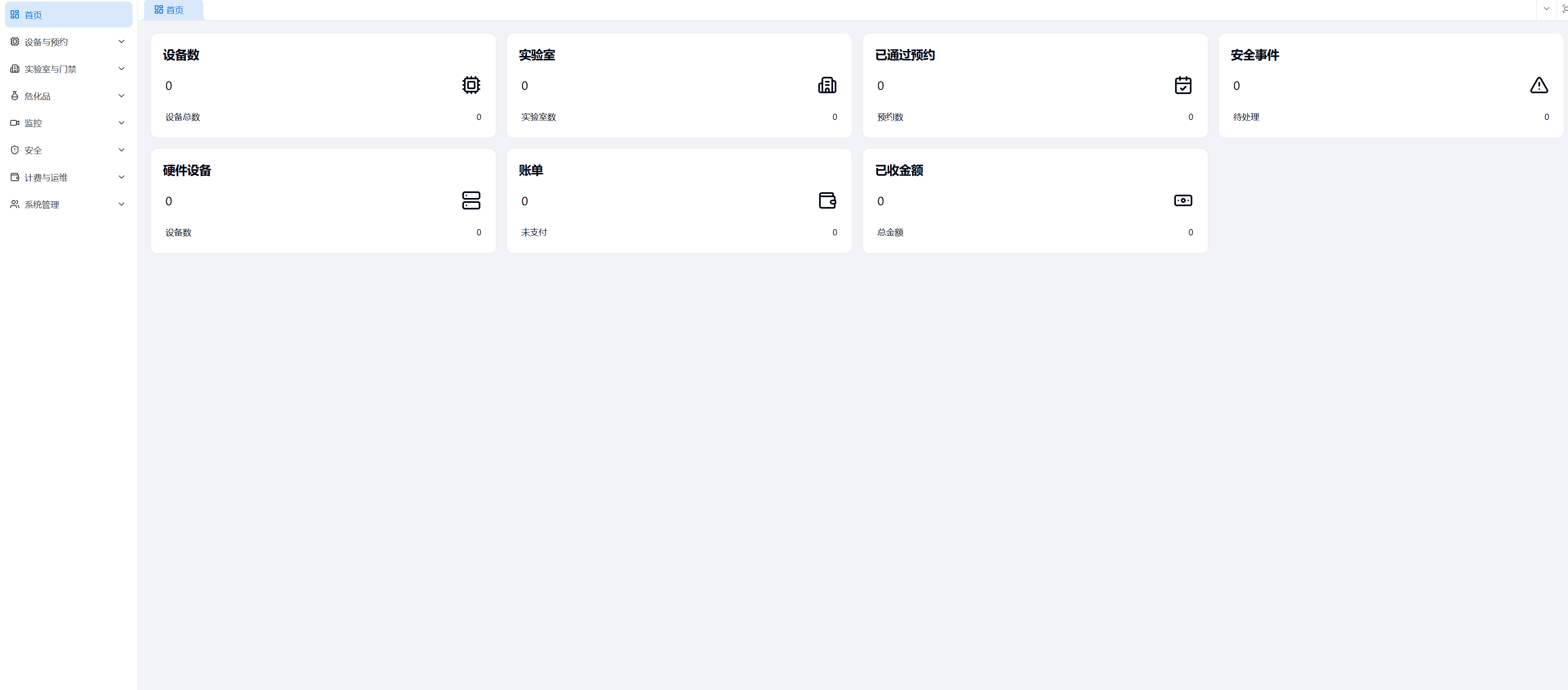
Equipment, access control, reservations, hazardous chemicals, safety exams, billing, and monitoring — all covered by one platform.